How to Choose the Right Size Garden Dining Set
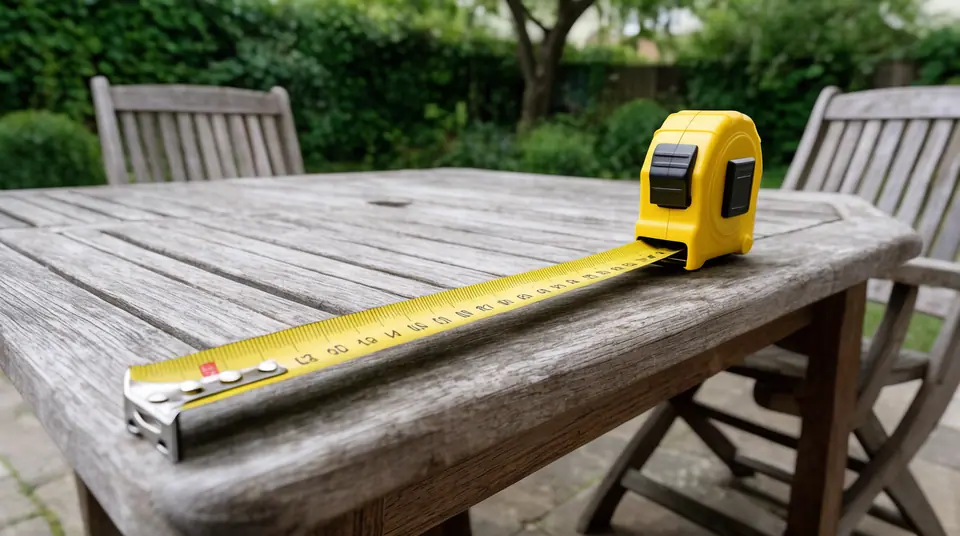
Allow about 60cm of table edge for each diner, and leave 75cm to 100cm of clear space behind the chairs. Add the two together and you can work out the patio area a dining set needs. These are rules of thumb and not fixed standards, so use them as a starting point and measure your own space.
How much table do you need for each person?
About 60cm of edge gives each person room to eat without bumping elbows. A table 150cm long therefore seats two people along each side, with room left over for a person at the end. Round tables work slightly differently, as the edge curves away and diners sit closer together.
A table about 90cm wide lets two people facing each other share dishes. Much wider than 100cm, and passing a plate becomes a stretch. Corner legs can catch knees, so sit at a corner when you try the layout.
Use 75cm behind the chairs if people only need to sit and stand. Go nearer 100cm if you need a walkway behind the seating, such as along a house wall.
Patio space for a 4, 6 or 8 seater
Take the table length and width, then add the chair clearance on every side where people will sit. A rectangular table 150cm by 90cm with seating along both long sides needs about 90cm plus 75cm to 100cm on each side, so roughly 240cm to 290cm across.
| Seats | Typical table | Space to allow |
|---|---|---|
| 2 | Round, about 60cm to 80cm across | About 2m by 2m |
| 4 | Square about 90cm, round about 110cm to 120cm, or rectangle about 120cm to 150cm | About 2.5m to 3m by 2.5m |
| 6 | Rectangle about 150cm to 180cm long, or round about 140cm to 150cm | About 3m to 3.5m by 2.5m to 3m |
| 8 | Rectangle about 180cm to 220cm long | About 3.5m to 4m by 2.5m to 3m |
Every figure here is approximate, so check the stated dimensions of the exact set. Our 4 seater, 6 seater and 8 seater pages go further on each capacity.
Is a round, square or rectangular table better?
Rectangular tables
These make the best use of a long, narrow patio. People sit in rows, and you can sometimes fit one more at each end. You do need a clear run along both sides.
Round tables
Round tables are friendly for conversation and good for awkward spaces because they have no corners. They seat slightly fewer people than a rectangle of similar footprint, and the middle of a large one is hard to reach.
Square tables
A square suits four people and sits well on a square deck. In the same area it seats fewer than a rectangle.
Extending tables
An extending table gives you flexibility. Measure it closed and open, and make sure you still have clearance when the leaf is out. Open it fully before you decide where it goes.
How the chairs change the footprint
Armchairs are comfortable but wide, so you may fit fewer around the same table. Chairs that tuck fully under the table take no room when not in use. Check the seat width against the table, and read the product details for the exact figures.
Chunky weave armchairs can make a six-seater need the space of an eight-seater, so count the real width of each chair and not the number on the box. Folding chairs are slimmer, and they can be stacked away when the table is not in use.
How tall should the table and chairs be?
A dining table is usually about 72cm to 76cm high, and dining chair seats sit around 45cm from the ground. That leaves around 30cm between seat and tabletop for legs. Armrests that sit below the tabletop let a chair tuck in. Low lounge tables, around 40cm to 50cm high, suit sofas and are poor for plates and cutlery. Heights vary between sets, so check the listing.
Can benches replace chairs at a dining table?
Yes, and they let you squeeze more people along one side, since nobody has a fixed width. A bench tucks under the table and takes less room when pushed in. The trade-offs are comfort and access. Most benches have no back, and the person in the middle cannot leave without everyone shuffling. Check the stated weight limit per seat. A common compromise is a bench on one side and chairs on the other.
How to test your plan before you buy
Lay down masking tape or chalk to the full table and chair dimensions. Put a few chairs from the house at the right distance and sit down. Then stand up, push the chair back and walk behind it. If that feels cramped, go down one size or look at a more compact design. It is cheaper to find that out with tape than with a delivery van outside.
Leave the tape down over a weekend and eat a meal at a kitchen table of the same size if you can. It sounds fussy, but it shows you quickly whether a person can reach the salt and whether the dog fits under the table. For very tight plots, our guide to garden furniture for small gardens suggests alternatives to a full dining set.
What else catches people out?
Parasol bases are easy to forget. If you use a parasol through a hole in the table, check where the base will stand and how much extra room it takes. A door that swings into the dining area, or a patio with a slight slope, can spoil an otherwise good layout, so check both with the tape down.
Extension leaves are the other trap. A set may fit when closed and not when open. Finally, think about access, because a large boxed table has to reach the patio through a gate or hallway. Ask for the packed size and weight, and check whether the table arrives in one piece or needs assembling on site. Two people usually need to carry the top of a large one.
Once the size is settled, browse garden dining sets and compare the listed dimensions. If you are still deciding on a material, read rattan vs aluminium garden furniture.